


We tested wild chaga, pure Inonotus mycelium and the “chaga” products sold as mycelium fermented grain. Then we asked a simple question: which of these actually looks like chaga?
Journal: International Journal of Molecular Sciences · Published: March 25, 2025 · Access: Open (CC BY 4.0) · doi:10.3390/ijms26072970
Key Takeaways
- Wild chaga canker is low in starch, high in melanin, and carries triterpenoids (inotodiol, trametenolic acid, lanosterol) and phenolics that can be measured.
- Mycelium fermented grain (MOG) products sold as chaga were 33 to 68% alpha-glucan, mostly starch from the grain they were grown on.
- None of the fermented grain products contained the chaga triterpenoids we quantified. Using NMR metabolomics, these products matched the profile of their grain substrate.
- No single test is enough. The paper lays out a layered collection of methods any QA lab can use to verify a chaga ingredient.
Why We Ran This Study
Chaga is one of the most popular functional fungi on the shelf. It’s also one of the easiest to get wrong.
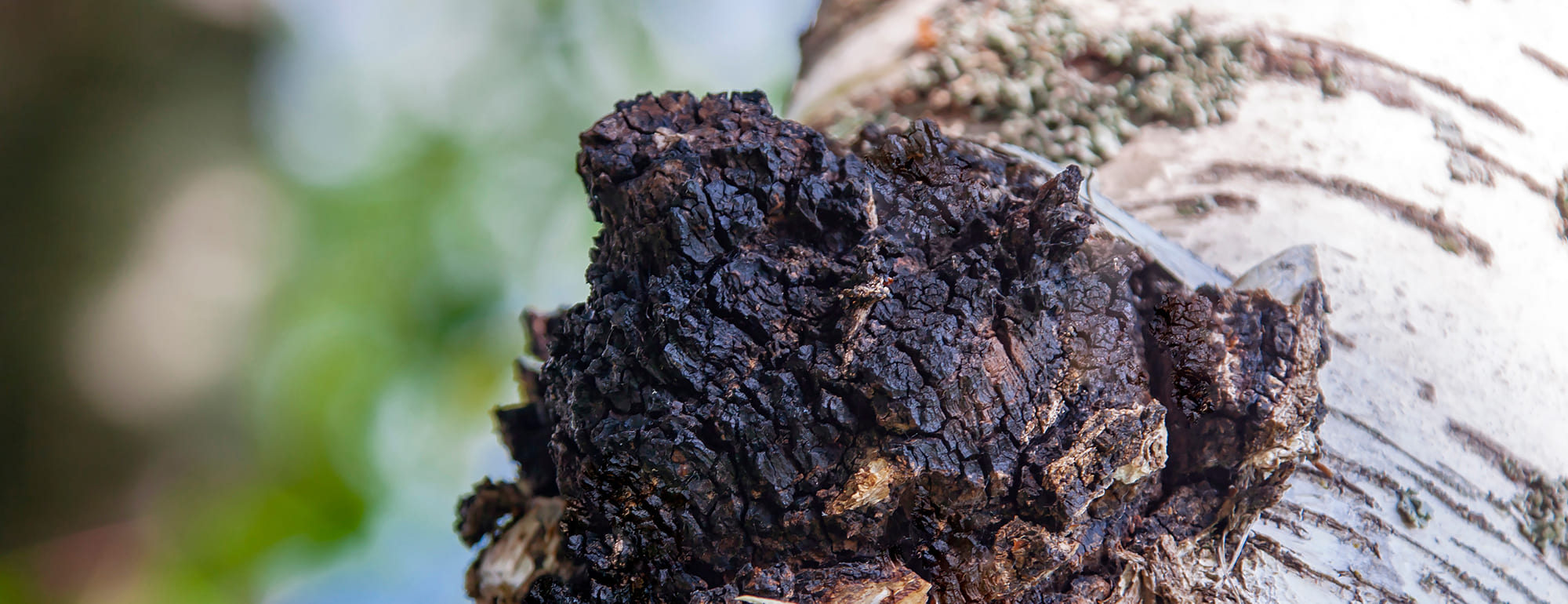
Real chaga is a sterile canker, the black, cracked growth that forms on birch trees. It is extremely difficult to cultivate at scale, so most chaga is wild harvested. But many products labeled “chaga” are something else entirely: Inonotus mycelium grown on oats, rice or sorghum, then dried and milled with the grain substrate remaining in it.
Those products often say “mushroom” on the front and sometimes disclose the grain in the Supplement Facts panel. Other times there’s no disclosure. We wanted hard numbers on what that difference looks like in the lab. And we wanted testing methods other labs could use.
What We Tested
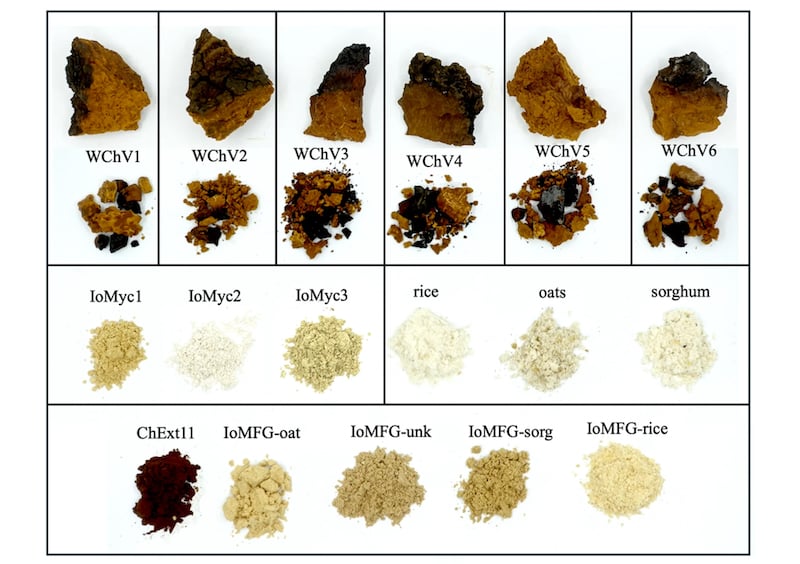
We collected 4 groups of samples and ran every group through the same set of methods, from a simple iodine starch test up to LC-QToF mass spectrometry.
Wild Chaga Canker
6 authenticated voucher specimens from China, Alaska, Quebec, Ontario and Finland, plus a 1:1 chaga extract.
Pure Inonotus Mycelium
Grown in liquid culture and on agar, with no grain involved.
Mycelium Fermented Grain Products
Commercial “chaga” products bought online, grown on oat, rice, sorghum and one unlabeled substrate.
Plain Grain
Cooked, freeze-dried oat, brown rice and sorghum, as a control.
What We Found
1. Starch Tells the Story
Fungi produce small amounts of alpha-glucans in the form of glycogen, whereas grain is mostly alpha-glucans in the form of starch. So alpha-glucan content (the starch fraction) is the quickest way to spot grain in a “mushroom” powder.
| Sample Group | Alpha-Glucan | Beta-Glucan |
|---|---|---|
| Wild chaga canker | Under 2% | 5.7–11.9% |
| Pure chaga mycelium (liquid culture) | 15.2% | 14.4% |
| Mycelium fermented grain products | 33–68% | 1.0–6.9%* |
| Plain grain (control) | 46–74% | n/a |
The fermented grain products aligned closely with the plain grain. A simple Lugol’s iodine starch test, run with and without alpha-amylase (the enzyme that breaks down starch), validated the numbers.
2. Beta-Glucans in Fermented Grain Were Actually Lower Than the Results
Wild chaga vouchers came in at roughly 5.7 to 11.9% beta-glucan. The fermented grain products came in at 1.0 to 6.9%.
There’s a catch. The standard beta-glucan assay also picks up oat beta-glucans, so for oat-based products, part of that number isn’t from the fungus. The real fungal beta-glucan content is lower.
Every fermented grain product we tested looked more like oats, rice or sorghum than like chaga.
3. Chaga’s Signature Compounds Were Missing
We validated an LC-DAD method to quantify 4 triterpenoids in wild chaga. In our reference voucher, we measured:
| Compound | Wild Chaga Canker | Pure Mycelium | Fermented Grain |
|---|---|---|---|
| Inotodiol | 0.19% | Not detected | Not detected |
| Trametenolic acid | 0.09% | Not detected | Not detected |
| 3β-hydroxylanosta-8,24-dien-21-al | 0.09% | Not detected | Not detected |
| Lanosterol | 0.06% | Not detected | Not detected |
HPTLC told the same story on a single plate. Two phenolic markers, osmundacetone and syringic acid, showed up only in the chaga samples. The fermented grain products showed bands for triglycerides and linoleic acid instead, which is what you’d expect from grain.
4. Melanin and Ergosterol Point the Same Way
Chaga’s black color comes from melanin. Wild chaga extracts had to be diluted 10 to 20 times to read on the spectrophotometer. The grain products barely registered undiluted.
Ergosterol is a fungal sterol, so it’s a good gauge of how much fungal tissue is in a sample. Grain product peaks were about one-tenth the height of wild chaga.
5. The Whole-Sample Fingerprints Settled It
NMR (nuclear magnetic resonance) gives you a snapshot of everything in a sample at once. Each fermented grain product lined up closely with the grain it was grown on.
Untargeted LC-QToF-MS found 11 chemical features present only in authentic chaga.
Before You Buy or Formulate with Chaga, Ask These Questions First
If you’re sourcing a chaga ingredient, these are the questions we’d ask your supplier, based on this data:
- What’s the alpha-glucan (starch) content? Wild chaga sits under 2%. Double digits means grain.
- Is beta-glucan tested by an enzymatic method, with alpha-glucan reported separately? “Polysaccharides” alone tells you nothing. Starch is a polysaccharide too.
- Is there an HPTLC identity test against an authenticated chaga voucher? Look for inotodiol and the phenolic markers.
- What does the label say on the front vs. the back? If the supplement facts panel lists oats, brown rice or “myceliated” grain, it’s a fermented grain product, not a chaga product.
Read the Full Paper
The study is open access. All figures, chromatograms and method parameters are in the published version.
Cite This Study
Windsor C, Kreynes AE, Chilton JS, Chioffi WA, Krishnamurthy A, Ishii M. Comparative Study of Chaga (Inonotus obliquus) Dietary Supplements Using Complementary Analytical Techniques. International Journal of Molecular Sciences. 2025;26(7):2970. doi:10.3390/ijms26072970
Affiliations: Nammex Mushrooms Inc., Gibsons, BC; Purity-IQ Inc., Guelph, ON.
Analytical collaborators: Purity-IQ (NMR), Loyalist College CNP (LC-MS and melanin analysis) and the University of Mississippi National Center for Natural Products Research (LC-ELSD/PDA).