


If a label says reishi, how do you prove it? Outside one USP monograph, there wasn’t a standard way to confirm a mushroom’s species. So we built one, and Eurofins now uses it.
Key Takeaways
- HPTLC separates the compounds in a sample into bands on a plate. Each mushroom species exhibits its own pattern.
- We built our fingerprints from authenticated voucher specimens of 12 species: whole mushrooms, conks and sclerotia.
- Mycelium fermented grain products line up on the plate with their corresponding grain substrate, not with the mushroom.
- Eurofins verified the method across 7 species in 2026 and adopted it for mushroom identification.
The Problem: Proving Species
Every supplement ingredient needs an identity test. For most botanicals, there’s an official method to follow. For mushrooms, there was one: the USP monograph for Ganoderma lucidum (reishi).
Commercial labs have been using the USP reishi method to analyze other species. But the method wasn’t designed for that, and it can’t reliably tell one mushroom from another.
Meanwhile, many products state “mushroom” on the label’s front panel and only reveal the grain in the Supplement Facts panel. A weak identity test can allow mycelium fermented grain to pass as the real thing.
What HPTLC Is
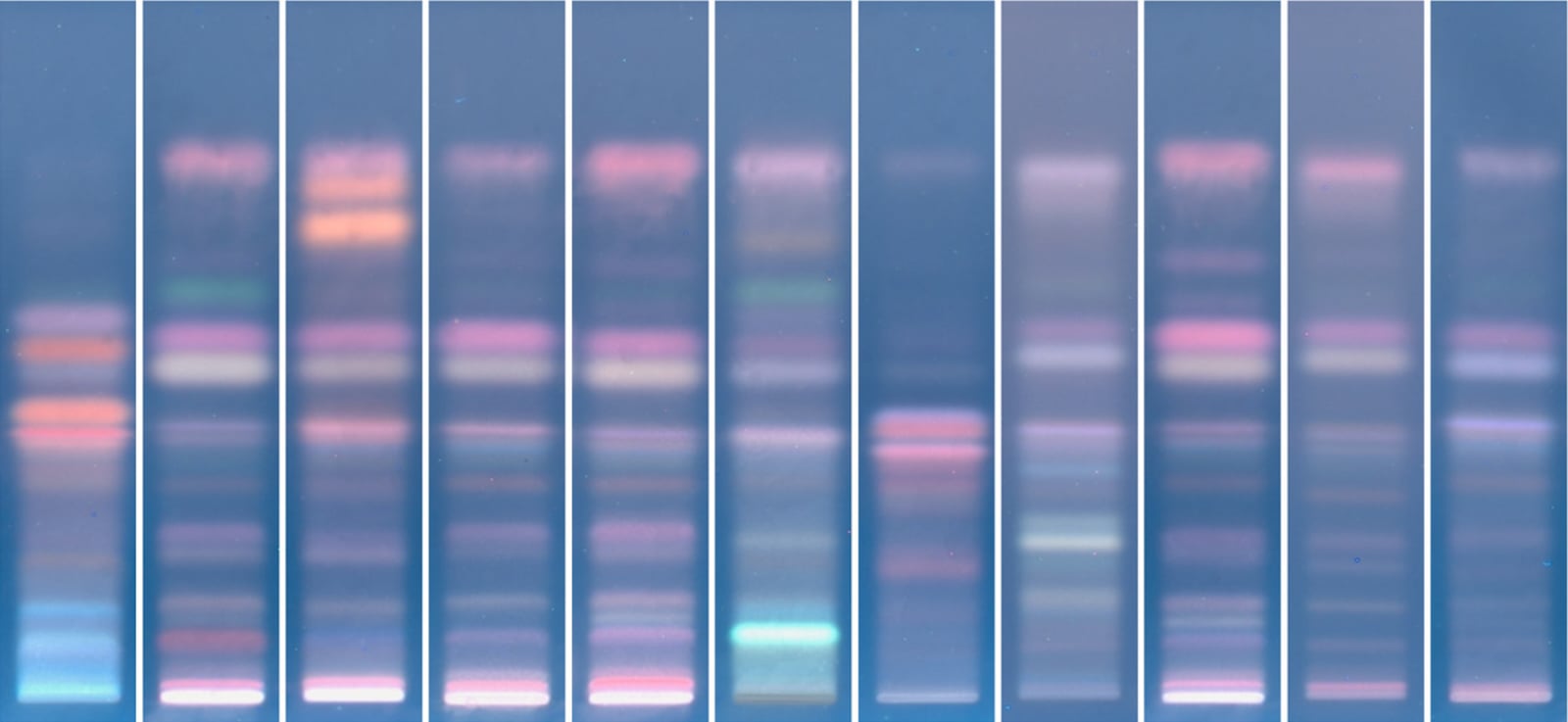
HPTLC stands for high-performance thin-layer chromatography. You spot small amounts of each sample along the bottom of a coated glass plate. A solvent climbs the plate and carries each compound a different distance. Then a reagent makes the compounds visible as coloured bands.
The result looks a bit like a barcode for each sample. And because samples run side by side, you can put a product, an authenticated reference specimen and a grain control on the same plate and compare them directly.
How Our Method Works
The fingerprints come from authenticated voucher specimens of 12 species, compared against pure mycelium, fermented grain products and plain brown rice and oats. The key settings:
| Step | Setting |
|---|---|
| Mobile phase | Toluene : methanol : acetic acid, 85:10:5 (v/v) |
| Chamber | Automatic development (CAMAG ADC 2), 20 min saturation, plate conditioned at 33% relative humidity |
| Development | 70 mm |
| Derivatization | Dip in p-anisaldehyde sulfuric acid reagent, heat at 100 °C for 4 min |
| Documentation | UV 254 nm and white light before derivatization; UV 366 nm and white light after |
What It Shows
Each Species Has Its Own Fingerprint
Different species clearly exhibit unique band patterns. This makes species-level identification possible and differentiates one species from another.
Marker Compounds Confirm It
Chaga is a good example. In our peer-reviewed chaga study, the plate picked out these markers by position (Rf):
| Marker | Type | Rf |
|---|---|---|
| Lanosterol | Triterpenoid | 0.56 |
| 3β-hydroxylanosta-8,24-dien-21-al | Triterpenoid | 0.50 |
| Inotodiol | Triterpenoid | 0.41 |
| Trametenolic acid | Triterpenoid | 0.39 |
| Syringic acid | Phenolic (chaga only) | 0.31 |
| Osmundacetone | Phenolic (chaga only) | 0.22 |
Grain Gives Itself Away
Fermented grain products didn’t show the chaga markers. They showed strong bands for triglycerides and linoleic acid instead, and their fingerprints closely matched plain oats and rice.
“Each species exhibited a distinct mycochemical fingerprint, enabling clear identification and differentiation.”
Eurofins Botanical Testing, August 2026
Independent Verification
In industry, an analytical method is only relevant if commercial labs can perform it. In 2026, Eurofins Botanical Testing adopted our method and verified it in-house across different sample types, extract types and growers. Their report states that it:
- Separately confirms at least 7 mushroom species: cordyceps (Cordyceps militaris), reishi (Ganoderma sp.), maitake (Grifola frondosa), lion’s mane (Hericium erinaceus), chaga (Inonotus obliquus), Chinese caterpillar fungus (Ophiocordyceps sinensis) and turkey tail (Trametes versicolor).
- Can be adapted for multi-ingredient blends.
- Distinguishes water extracts from crude powders.
- Supports lot-to-lot comparisons.
Where We Use It
Published Research
HPTLC is one of the core methods in our peer-reviewed chaga study, alongside LC, NMR and mass spectrometry.
Reference Materials
Our reference specimens are only useful if their identity is beyond doubt. For lion’s mane, we confirm each voucher by morphology and DNA sequencing, then fingerprint it by HPTLC, with HPLC and independent NMR as cross-checks. We presented this at the 2026 Oxford International Conference on the Science of Botanicals (read more). The same work supports our advisory role in AOAC’s Botanical Identity and Dietary Supplements Integrity (BIDSI) program, where a species-specific standard (SMPR) for lion’s mane is in development.
What HPTLC Doesn’t Do
- It confirms identity. For potency and purity, pair it with quantitative tests like beta-glucan, starch and ergosterol.
- Reading a plate is partly visual and semi-quantitative. Densitometry helps, but it isn’t a substitute for HPLC when you need exact amounts.
- It’s only as good as its references. The reference has to match the species and the part being claimed. Pure mycelium, for example, has a different fingerprint than the mushroom.
Want to Run It?
We share the method with QA teams, contract labs and brands who want to verify mushroom identity themselves. Tell us which species you’re testing and we’ll send what you need.
Timeline and Sources
- November 2024. Ensuring Quality of Functional Mushrooms with HPTLC, Coleton Windsor, CAMAG CBS 133. Plus a webinar with CAMAG.
- March 2025. Comparative Study of Chaga Dietary Supplements, International Journal of Molecular Sciences 26(7):2970.
- April 2026. Authenticated Hericium erinaceus Mushroom and Selected Mycelia Reference Materials for General Industry Use, Steven Dentali, ICSB 2026.
- August 2026. Improving Confidence in Mushroom Testing: A New Approach to HPTLC Identification, Eurofins Botanical Testing.